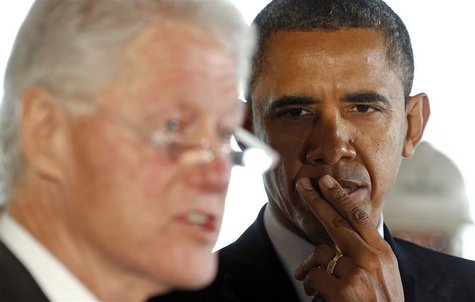
The Hill: “Using comments by former President Bill Clinton as a political gift, Republican leaders stepped up their calls for at least a one-year extension of the George W. Bush-era tax rates. One by one, senior congressional Republicans stepped before the cameras on Wednesday morning to trumpet Clinton’s momentary support for extending the full slate of current tax rates, in contrast to President Obama’s push to keep income rates in place only for the middle class. . . . Republicans jumped on the comments immediately and made Clinton’s remarks the focus of their morning press briefing. The Senate Republican leader, Mitch McConnell (Ky.), made a rare walk across the Capitol to join House Republicans and echo their message. He noted that the economic growth rate is lower than it was in late 2010, when Obama agreed to a deal that extended the Bush tax rates, including those for the wealthy, for two years.”
Clinton told CNBC, “I think what it means is they will have to extend… have to put everything off until early next year. That’s probably the best thing to do right now… I don’t have any problem with extending all of it now.”The Wall Street Journal noted last night, “Former Democratic President Bill Clinton suggested Tuesday that Congress temporarily extend all the Bush-era tax cuts, undercutting President Barack Obama’s position that the rates on upper-income Americans should rise at year’s end. It was the second example in recent days of Mr. Clinton taking a position at odds with that of Mr. Obama . . . .”
But President Clinton isn’t alone among Democrats in making the case that we shouldn’t raise taxes at the end of the year. According to the WSJ, “Lawrence Summers said Wednesday that Congress should temporarily extend Bush-era tax cuts, making him the second person with ties to the White House who is undercutting President Barack Obama’s position that the rates on upper-income Americans should rise at year’s end. ‘The real risk to this economy is on the side of slow down…and that means we’ve got to make sure that we don’t take gasoline out of the tank at the end of this year,’ he said on MSNBC’s ‘Morning Joe’ program. ‘That’s gotta be the top priority.’”
The WSJ adds, “Mr. Summers’s comments will likely further complicate Mr. Obama’s efforts to ensure the tax cuts expire at year’s end… and his comments will likely carry more weight because of his economic credentials.” Of course, it’s worth recalling that Summers was once a top economic advisor to President Obama and before that was Treasury Secretary for President Clinton
This afternoon, the Senate will vote on whether to begin debate on a bill Democrats are deceptively calling the “Paycheck Fairness Act,” but in fact the bill is yet another in a series of Democrat show votes that’s designed to fail for political purposes. Moreover, the bill’s substance would hurt employers, impose ever more regulations, and is yet another giveaway to trial lawyers.
A coalition of jobs groups, including the U.S. Chamber of Commerce, the National Federation of Independent Business, and the National Association of Manufacturers, wrote to Senate leaders opposing the bill. They wrote, “The provisions of the Paycheck Fairness Act would harm employers of all sizes, as the bill would apply to employers with as few as two employees. The threat the bill poses to small business is particularly troubling given the draconian penalties found in this legislation . . . .”
In a must-read editorial today, The Wall Street Journal explains what this Democrat bill is really about: “Majority Leader Harry Reid is back with this trial lawyer doozy [the Paycheck Fairness Act] just in time for 2012 election ads. Democrats last rolled out this attempt to equalize pay between men and women in 2010, when it also failed to get enough votes. Funny how this always seems to come up in election years. Mr. Reid knows the bill is doomed again, and that’s more or less the point. The White House and Democrats will be happier if it doesn’t pass.”
The Washington Post acknowledges this, writing, “The measure will fail, as intended, because at its core it is not so much a legislative vehicle as a political one . . . .”
Importantly, the WSJ editors point out, “The U.S. already has two broad federal laws—the 1964 Civil Rights Act and the 1963 Equal Pay Act—that prohibit gender-based pay discrimination. In case that wasn’t enough, Congress passed the Lilly Ledbetter Act in 2009 that as recently as March Mr. Obama said ‘ensures equal pay for equal work.’ What changed in the last three months?”
On the substance, the WSJ editors explain Democrats’ “bill would rewrite labor law to require businesses to comply with a raft of new regulations in which businesses would have to justify their pay decisions. The practical effect would be to restrict flexibility in employee compensation, as employers got rid of bonus programs and other pay perks lest they open themselves up to discrimination claims. The bill ought to be called the ‘Trial Lawyer Paycheck Act,’ since it is a recipe for a class-action boom. The law automatically lists women as plaintiffs in class actions when lawyers sue employers, thereby requiring female employees to opt-out of litigation with which they don’t agree. Businesses would be treated as guilty until shown to be innocent, having to prove in court that their pay practices aren’t the result of workplace bias. The legislation contains no caps on damage awards, allowing plaintiffs to claim unlimited punitive damages even in cases of unintentional discrimination.”
And it’s not just The Wall Street Journal editors who’ve found this bill to be ill-considered legislation. The Chicago Tribune’s editors called it “grossly intrusive on decision-making by private businesses” and emphasized, “At least one group would get a fatter paycheck from the Paycheck Fairness Act: trial lawyers.” A Washington Post editorial called the bill “[a] flawed approach” that’s “not the right fix.” In fact, the editors said the bill “risks tilting the scales too far against employers and would remove, rather than restore, a sense of balance.” Even The Boston Globe editors wrote, “The bill would create too strong a presumption in favor of discrimination over other, equally plausible explanations . . . .” And, they said, “companies are right to be concerned that this bill, as written, is too deep an intrusion.”
The WSJ editors are unsparing in their conclusion: Democrats’ “Paycheck Fairness Act” “[is] a walking advertisement for gridlock, a partisan stunt that would hurt the economy for no other reason than to pay off the Democratic donors in the tort bar.
Found this little gem in our inbox on Sunday. Enjoy!
Alright, so I don’t care how many down-votes this gets…But I HAVE to vent this here. Following info I gathered going through Missouri State convention thread.
I’ve had it!!! In St. Charles County, Missouri (Ron Paul clean sweep county for first choice & alternate delegates), there were 294 total delegates – first choice + alternate. Only 140 showed up for State Convention. Where the *^$! were rest of 154 of them?!?! Watching Cartoon Network channel?!?!? I’m so furious, my blood is boiling.
Is this what Brent Stafford went to jail for, in the first St. Charles county caucus? Is this what all patriots donated to moneybombs for, so our delegates would stay home? Don’t they know about sacrifices of all those patriot delegates in Maine, how much they achieved? Couldn’t they appreciate Brent Stafford’s sacrifices?!?!
Final Missouri convention numbers were: 1025 voted on a slate of FASCISM supporting delegates vs. 781 for US Constitution. Remember, the fascists had multiple candidate allegiances with them – Romney + Santorum + Gingrich, all going against supporters of 1 single patriot candidate.
This is making ABSLOUTELY NO SENSE! Is it likely there were some no-shows from Kansas City and St. Louis either? Considering margin of votes above, our no-shows showing up HAD to have bridged the gap. How can this happen?!?! People supporting Ron Paul cause simply DO NOT fail to show up. It just ISN’T supposed to happen. Especially for someone to have motivation to become a delegate, but not showing up at the most critical time? To me, this amounts to nothing short of treason. There is too much at stake here. The Republic is on the verge of a collapse.
Has this campaign been sabotaged from the inside – with Benton & Tate issuing absurd press releases? Doug Wead has gone TOTALLY SILENT both on his blog as well as Facebook.
I have been on record in other places, defending those campaign guys of playing a “Possum” strategy. But “Play Possum” can only work if all our delegates show up en-mass for conventions. NOT if the delegates themselves start doing “Play Possum”.
You know, after the euphoria of Nevada + Maine + Minnesota, things have suddenly stopped making any sense whatsoever. It’s almost like the wheels have come off the rails at the most glorious point of our campaign. [Talking about built up frustration of Arizona & Washington convention as well.]
On the heels of Friday’s dismal jobs report, there’s quite a bit of bad economic news today reflecting the state of the Obama economy.
USA Today writes, “The economy isn’t careening into a ditch. It’s just stuck firmly in the slow lane. A disappointing report on the job market Friday dashed hopes that a halting recovery would finally take off and generate hundreds of thousands more jobs every month. Though the economy is growing, it still doesn’t feel that way for millions of Americans who are unemployed or whose wages are barely rising. . . . ‘2012 is beginning to look horribly like 2011 — initial high hopes that the recovery was kicking into high gear, subsequently dashed,’ Nigel Gault, chief U.S. economist of IHS Global Insight, said in a research note to clients. . . . [T]he nation still has 5 million fewer jobs than it did when the recession began in December 2007. About half the states will recover all their lost jobs by next year, economist Jim Diffley of IHS Global Insight estimates. But that’s more than twice as long as it took in the last four recoveries. All 8.7 million jobs lost in the downturn won’t be recouped until 2016, IHS projects. Most disconcerting: Job growth revved up at the beginning of 2010, 2011 and this year before slowing markedly each spring. From December through February, employers added an average 252,000 jobs a month. But job gains have progressively slowed the past three months. In May, employers added just 69,000, the fewest in a year, the Labor Department said Friday.”
And The Wall Street Journal reports, “The Dow has given back all of this year’s gains and is down 8.7% from the multiyear high of 13279.32, reached May 1. . . . The dour U.S. unemployment news Friday was bolstered with data showing that U.S. manufacturing had cooled in May, and that consumer spending rose faster than incomes in April—suggesting household finances remain strained. The Labor Department’s report was the third consecutive month of disappointing payroll gains. It followed a government report on Thursday that lowered its estimate of economic growth in the first quarter to a weak 1.9% annualized rate.”
This ongoing economic gloom is clearly worrying Americans. According to Gallup, “Nearly six in 10 Americans are currently dissatisfied with the opportunity for the next generation of Americans to live better than their parents. Older Americans are particularly unhappy on this question, but on balance, the majority of young adults are negative as well. . . . These results are based on a USA Today/Gallup poll conducted May 10-13 and could have implications for how Americans perceive President Barack Obama’s job performance when deciding whether to support his re-election bid next fall.”
As Senate Republican Conference Chairman John Thune said on Friday, “[This] weak jobs report further confirms what nearly 13 million unemployed Americans already knew, that the Obama economy isn’t working. It isn’t working for the one in two recent college graduates who can’t get a good job. It isn’t working for middle class families whose median income has dropped by $4,350. And it isn’t working for the 28,000 construction workers who lost their jobs in the month of May. Yet President Obama continues to block job-creating projects like the Keystone XL pipeline, which would create 20,000 jobs, many in the construction industry. The president’s policies of wasteful government spending, massive tax increases, and more job-killing regulations have failed to get Americans back to work. After a record 40 straight months of unemployment above eight percent, it is clear that President Obama’s policies have made the economy worse.”
The American reports on the shady dealings going on in St. Louis City’s Democratic sixth ward where NO African Americans were endorsed a couple of weeks ago. Excluded from an endorsement was former legislative aide Michael Butler who is running against school choice advocate and Wahby protege Martin Casas. It seems they had cover:
“Other St. Louis Black elected officials donating to Casas were Board of Alderman President Lewis Reed ($550) License Collector Mike McMillan ($150) Alderwoman Kacie Starr Triplett ($50) Alderman Jeffrey Boyd ($150).”Read more…
STL American:
Driving dirty because you didn’t pay your parking tickets, then running to be elected to be the parking meter czar? That’s just Brian Wahby being Brian Wahby.
Remaining seated as a presumably neutral Democratic Party chair for the city of St. Louis while running in a contested citywide Democratic Party? That’s just Wahby being Wahby.
Serving as presumably neutral Democratic Party chair for the city of St. Louis while exploiting the fine print in a ward organization’s bylaws to win that ward’s endorsement by stacking the organization with brand new members loyal to you? Just Wahby again being Wahby.
Several Democratic leaders in the 6th Ward are extremely irritated with the tactics that Wahby used to win the 6th Ward endorsement. Wahby used the liberal voting rules in the 6th Ward bylaws that allow same-day membership and absentee voting to recruit voters who had never been members of the ward organization to “stack” votes for him. Read more…
Disappointing reports about the state of the American economy filled the news last Friday:
The AP: “The U.S. economy suddenly looks a lot weaker. U.S. employers created only 69,000 jobs in May, the fewest in a year, and the unemployment rate ticked up. The dismal jobs data will fan fears that the economy is sputtering. . . . The Labor Department also said Friday that the economy created far fewer jobs in the previous two months than first thought. It revised those figures down to show 49,000 fewer jobs created. The unemployment rate rose to 8.2 percent from 8.1 percent in April, the first increase in 11 months.”
The Wall Street Journal adds, “U.S. job growth fell sharply, jolting financial markets and raising new questions about the strength of the nation’s economy. The U.S. added a paltry 69,000 jobs in May, the lowest total in a year. April brought only 77,000 new jobs, far lower than initially reported. The jobless rate climbed for the first time since last summer, to 8.2%. And the manufacturing sector, a previous source of strength, is slowing. The collection of dismal reports comes on top of growing fears about European and Asian economies, and sent stocks sliding Friday morning. . . . ‘The economy is shifting from “muddling through” to paralysis,’ Pierpont Securities economist Stephen Stanley said
Last Friday’s jobs numbers follow a report in the WSJ Thursday that “[t]he U.S. grew slower during the first quarter than previously thought and continued weakness in the job market and elsewhere suggests the economy is struggling to gain traction. On Thursday, the government said gross domestic product—the broadest measure of all goods and services produced in the economy—grew in the January-to-March period at an annualized 1.9% pace, short of the 2.2% growth previously estimated. This means the economy had less momentum going into the second quarter and comes as fears are growing that a larger global slowdown is under way that could eventually weigh on domestic growth.”
Economists were certainly troubled by the report. Jeffrey Greenberg of Nomura Economics Research told the WSJ, “This is what a jobless recovery looks like. . . . [T]he hiring environment appears to have weakened, and anxiety about the outlook seems to have led many employers to put hiring plans on hold.” Credit Suisse’s Jay Feldman said, “[T]he prior two months were revised down by 49,000 – the first downward revision in 5 months. April itself was lowered to just +77,000 from the previously reported +115,000, making the last two months look awful. The -62,000 private sector revision was the largest in three years.” Peter Newland of Barclays Capital called the news “[a] clearly soft report that suggests a loss of momentum in the labor market recovery across jobs, hours worked and the unemployment rate.” And MSNBC’s Chuck Todd tweeted that even Democrats’ oft-cited economist “Mark Zandi said on @dailyrundown there was little redeeming in this jobs report. All bad news.”
Looking back on 2009, it’s clear that the nearly $1 trillion stimulus bill that President Obama and Democrats jammed through Congress hasn’t lived up to the promises they made when it was passed. The administration’s top economic advisors claimed that unemployment wouldn’t exceed 8% if the stimulus was passed. President Obama claimed, “It’s a plan that will save or create up to 4 million jobs over the next two years.” Senate Majority Leader Harry Reid (D-NV) declared, “This bill creates 3.5 million jobs.” And Vice President Joe Biden boasted that the stimulus “literally drop-kicks us out of this recession” by creating “3.5 million jobs” in “18 months.”
In a must-read column yesterday, George Will discusses a potential challenge to the Supreme Court’s Citizens United ruling that the high court will consider taking up in a few weeks.
Roll Call reports on the background of the case: “The high court signaled this week that it would meet in private conference on June 14 to decide how to proceed in the case, which turns on a constitutional challenge to a 100-year-old Montana corporate spending ban. The Citizens United ruling, which ended decades-old limits on direct corporate and union spending, technically nullified the Montana law. But the state refused to take its corporate spending ban off the books. A trio of corporations then challenged the ban as unconstitutional, but in December the state Supreme Court sided with Montana and upheld the law. The Supreme Court stayed that ruling in February. The high court will now decide as early as June 15-18 whether to summarily reject the state Supreme Court’s ruling, as the corporations challenging the law have requested.”
Will explains, “Three Montana corporations sued to bring the state into conformity with Citizens United by overturning a 100-year-old state law, passed when copper and other corporations supposedly held sway, that bans all corporate political spending. The state’s Supreme Court refused to do this, citing Montana’s supposedly unique susceptibility to corporate domination — an idea amusingly discordant with the three corporations’ failure even to persuade the state court to acknowledge the supremacy of the U.S. Supreme Court.”
Will writes, “Reasons for the Supreme Court to reconsider Citizens United are nonexistent. The ruling’s primary effect has been to give unions and incorporated nonprofit advocacy groups freedom to spend what they choose on political speech as long as they do not coordinate with candidates or campaigns. Campaign ‘reformers,’ who advocate speech rationing, apparently regard evidence irrelevant to argument, probably because there is no evidence for their assertion that 2012 has been dominated by corporate money unleashed by Citizens United. An amicus brief submitted to the Supreme Court by Sen. Mitch McConnell, Congress’s staunchest defender of the First Amendment, notes:
“Through March 31, the eight leading super PACs supporting Republican presidential candidates received contributions totaling $96,410,614. Of this, $83,220,167 (86.32 percent) came from individuals, only $13,190,447 (13.68 percent) from corporations, and only 0.81 percent from public companies. McConnell says, “Not a single one of the Fortune 100 companies has contributed a cent” to any of the eight super PACS. These facts refute such prophesied nightmares as The Post’s fear that corporate money “may now overwhelm” individuals’ contributions.”
Will also points out, “Before Citizens United removed restrictions on independent expenditures by for-profit corporations, a majority of states already had no such restrictions. Neither did they have records of distinctively bad behavior. Indisputably, this year’s super PACs have, as McConnell’s brief says, ‘led to more political debate over a lengthier period of time during which more voters had the opportunity to participate in the choice of a presidential candidate.’ As McConnell notes, the Montana court’s ruling is ‘disdainful’ and disobedient regarding the Citizens United decision, but this lawlessness is not what bothers many people who think of themselves as defenders of good government. Instead,” Will argues, “much of the media and most liberals urge Americans to be scandalized about ‘too much money’ in politics. That three-word trope means (because most political money is spent on the dissemination of political advocacy) that there is more political speech by others than is considered proper by much of the media, which are unrestricted advocates.”
As Will concludes, “The collapse of liberals’ confidence in their ability to persuade is apparent in their concentration on rigging the rules of political persuasion. Their problem is that the First Amendment is the rule.”
In a Saturday Fact Check, the AP wrote, “The White House is aggressively pushing the idea that, contrary to widespread belief, President Barack Obama is tightfisted with taxpayer dollars. To back it up, the administration cites a media report that claims federal spending is rising at the slowest pace since the Eisenhower years. . . . The MarketWatch study finds spending growth of only 1.4 percent over 2010-2013, or annual increases averaging 0.4 percent over that period. Those are stunningly low figures considering that Obama rammed through Congress an $831 billion stimulus measure in early 2009 and presided over significant increases in annual spending by domestic agencies at the same time the cost of benefit programs like Social Security, Medicare and the Medicaid were ticking steadily higher. A fairer calculation would give Obama much of the responsibility for an almost 10 percent budget boost in 2009, then a 13 percent increase over 2010-2013, or average annual growth of spending of just more than 3 percent over that period.”
The Wall Street Journal editors added, “[White House Press Secretary Jay] Carney the media critic deeply sourced his view to someone named Rex Nutting, who wrote an 856-word column for MarketWatch that argued ‘There has been no huge increase in spending under the current President, despite what you hear.’ Mr. Nutting claims that spending is rising at 1.4% annually, versus 8.1% for George W. Bush’s second term. How did he manage to suss out the insights that have eluded every other human being who has spent time with the historical budget tables? His accounting methods are, er, unusual.
“Mr. Nutting claims that Mr. Obama is only responsible for $140 billion worth of spending in his hyperactivist first year in office because . . . the fiscal year technically begins on October 1, 2009. Therefore he says Mr. Obama had no control over the budget, though in February 2009 he did famously manage to pass an $800 billion stimulus that was supposed to be a one-time deal. Mr. Nutting then measures Mr. Obama’s spending growth rate against an inflated 2009 baseline that includes the spending Mr. Obama caused but which he attributes to Mr. Bush. This is like an alcoholic claiming that his rate of drinking has slowed because he had only 22 beers today and 25 beers yesterday.”
Further, the WSJ editors pointed out, “The larger conceptual error of the Nutting-Obama-Carney troika is neglecting to compare the budget to the size of the economy. The best perspective on how outlays, tax receipts and deficits change over time is as a share of GDP. Those data reveal historical trends because they account for different inflation rates and include changes over society as a whole like population growth. Prior to Mr. Obama, the U.S. had not spent more than 23.5% of GDP—that was in 1983, amid the Reagan defense buildup—since the end of World War II. Yet Mr. Obama has managed to exceed that four years in a row: 25.2% in 2009, 24.1% in 2010 and 2011, and an estimated 24.3% in 2012, up from a range between 18%-21% from 1994-2008. Democrats try to explain this away by saying that the economy is lousy, so spending’s share of GDP looks larger than it would be with faster growth. But that is hardly an endorsement of Mr. Obama’s economic policies, and in any case the recession officially ended nearly three years ago, in mid-2009.”
The AP piece concludes, “So how does Obama measure up? If one assumes that TARP and the takeover of Fannie and Freddie by the government as one-time budgetary anomalies and remove them from calculations . . . you get the following picture: —A 9.7 percent increase in 2009, much of which is attributable to Obama. —A 7.8 percent increase in 2010, followed by slower spending growth over 2011-13. Much of the slower growth reflects the influence of Republicans retaking control of the House and their budget and debt deal last summer with Obama. All told, government spending now appears to be growing at an annual rate of roughly 3 percent over the 2010-2013 period, rather than the 0.4 percent claimed by Obama and the MarketWatch analysis.”